N2N Services · Higher education · Generative AI, Agentic AI, Predictive AI · Published 2026-11-02
Five AI products on Amazon Bedrock: 29 times the AI usage, a third less platform cost
AXIOMIO built and runs LightLeapAI for N2N Services: five AI products and an agent platform on Claude models in Amazon Bedrock, serving more than 40 institutions. Model requests grew about 29 times while the cost of everything else fell about 33%.
Built on AWS with: Claude Opus 4.8, Claude Sonnet 4.6, Claude Haiku 4.5, Claude Opus 4.7, Amazon Nova Pro, Cohere Embed Multilingual v3, Amazon Titan Text Embeddings V2
Results at a glance
- About 29x more Amazon Bedrock model requests a month
- About 33% lower monthly AWS cost outside model usage
- About 98% lower cost of self-hosted model endpoints
- 87% to 93% of input tokens served from the prompt cache
About N2N Services
Higher education technology company in Duluth, Georgia, with fifteen years connecting campus systems and more than 500 institutions using its products. Location: Duluth, Georgia, USA.
Overview
N2N Services is a higher education technology company in Duluth, Georgia, with fifteen years of experience connecting campus systems and more than 500 institutions using its products. Its LightLeapAI platform has five products: Meridian builds governed campus applications from a prompt, Orion detects application and identity fraud, Prism reads and reviews documents, Polaris supports students and advisors, and Omnia answers leadership questions about institutional data in plain language.
N2N needed an isolated environment for every institution, access to the strongest available models without hosting models on its own GPUs, and room for AI usage to grow without the rest of the cloud bill growing with it. Its earlier AI work ran on self-hosted models on GPU endpoints that were costly to keep running and slow to change.
AXIOMIO built the five products and Helios, the integration and agent platform beneath them, on Claude models in Amazon Bedrock, and runs the platform. Each of more than 40 institutions runs in its own environment on Amazon ECS with AWS Fargate, and the document, embedding and fraud pipelines run on AWS Step Functions. Between January and September 2026, Bedrock model requests grew from about 7,000 to about 200,500 a month, while the monthly cost of everything other than model usage fell from about $78,500 to about $52,400.
The challenge
- Self-hosted models that were expensive to run. Earlier AI features ran on open models on Amazon SageMaker GPU endpoints that cost about $16,200 a month in January 2026, ran around the clock whether used or not, and made every model change a hosting project.
- Every institution needs its own environment. Institutions share student, enrollment and financial records protected by FERPA, and each expects its data and users kept apart. New institutions had to be added without hand-building another stack.
- A platform cost already high before AI. The platform already cost about $78,500 a month, with container compute alone at about $35,200. For AI usage to grow, the rest of the platform had to cost less.
- Many models and no single control point. Five products need different models for different tasks. N2N needed one governed way to reach them, with every call logged to an identity, screened where users type free text, and reported by model and cost.
- Data arriving from many campus systems. Student information systems, learning management systems, application feeds and nightly file transfers all had to land in each institution's own place.
The solution
- Claude models on Amazon Bedrock replace self-hosted models (Generative AI). Each task is matched to a model: Claude Sonnet 4.6 for conversation, Claude Haiku 4.5 for short high-volume steps and Claude Opus 4.8 for the hardest reasoning, such as generating a governed application in Meridian. Model settings live in DynamoDB, so changing a model is a configuration change, not a release, and the SageMaker GPU endpoints were retired.
- Prompt caching on every long conversation. Assistant calls were designed for Amazon Bedrock prompt caching. Since May 2026, between 87% and 93% of input tokens each month have been read from the cache, billed at a fraction of the standard input price.
- Helios: the integration and agent layer (Agentic AI). A gateway, agent service, authentication service, API dictionary and connector library on Amazon ECS. The agent uses Claude Opus 4.7 to choose and call the right campus APIs, so Polaris answers with the student's own records. The dictionary exposes only read operations, and every call runs under the signed-in user's identity.
- One isolated environment per institution. Each of more than 40 institutions runs in its own ECS cluster with its own load balancer and AWS WAF web ACL, deployed from the same AWS CDK template, with target tracking auto scaling on every service.
- Document intelligence for Prism (Generative AI). Files arrive through AWS Transfer Family or upload. A Step Functions workflow reads them with Amazon Textract, summarizes them with Claude, and stores Cohere embeddings in Aurora PostgreSQL so staff search documents by meaning.
- Fraud scoring for Orion (Predictive AI). Application batches are split by Step Functions and scored in Lambda with fraud models AXIOMIO trains in SageMaker with XGBoost, scikit-learn and Random Cut Forest, then sent through Amazon SQS for the admissions team to review.
- Campus data without manual exports. Lambda functions synchronize student and course data from the SIS, including Ellucian Banner through Ellucian Ethos, and Redshift Serverless holds Canvas LMS activity for Omnia.
- Paying for AI by running the rest for less. GPU endpoints retired, Fargate services right-sized and auto scaled, Compute Savings Plans on the steady load, SFTP endpoints consolidated, and cost reviewed monthly by service and by model.
Architecture
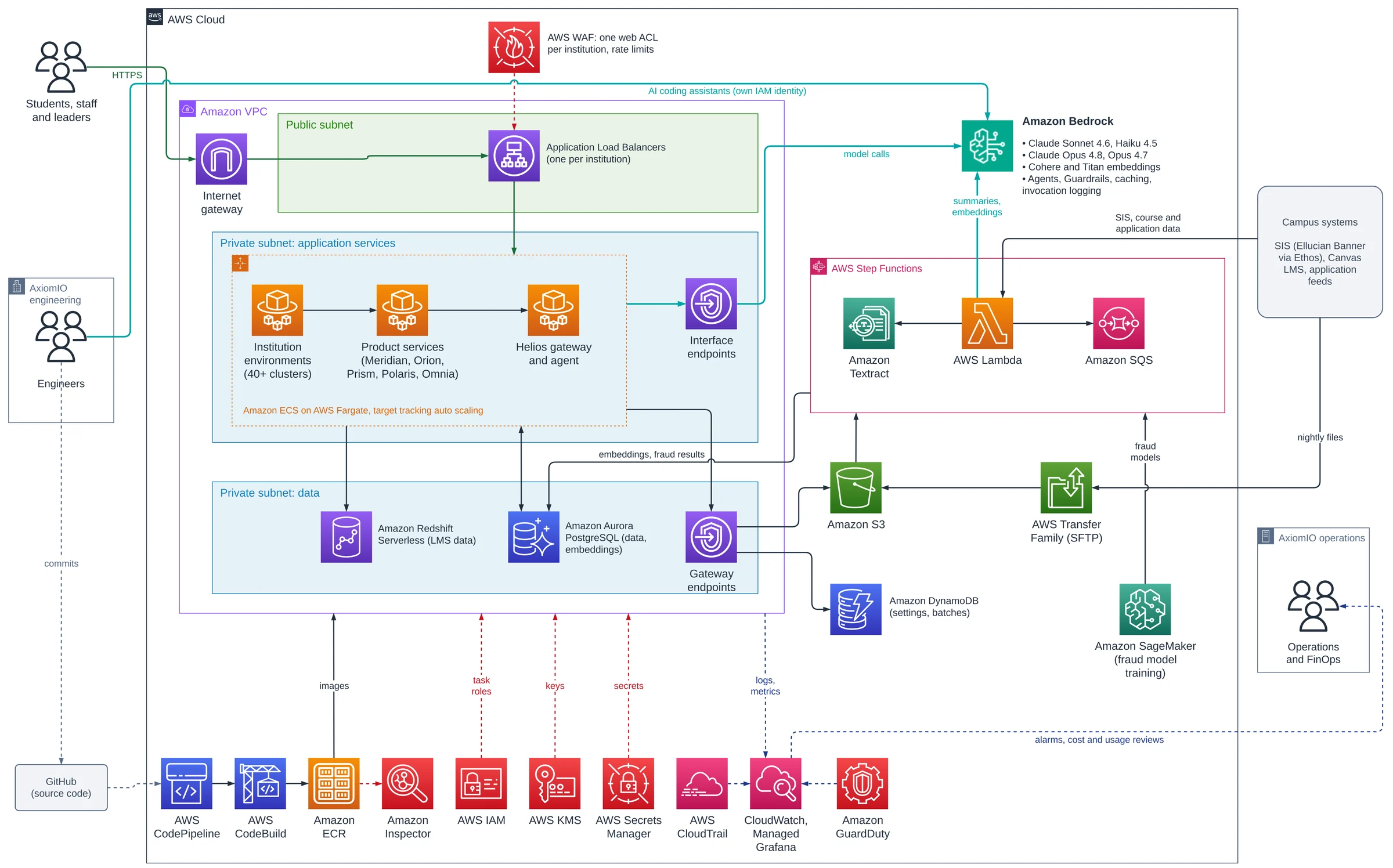
- Students, staff and leaders sign in to their institution's own environment. Requests pass through that institution's AWS WAF web ACL to its load balancer and services on ECS with Fargate in private subnets. The shared product services and the Helios gateway and agent run the same way in their own clusters.
- Services call Amazon Bedrock through interface VPC endpoints. Calls that carry student information use US geographic inference profiles. Bedrock Guardrails screen every prompt users type into Meridian, Polaris and Omnia, and model invocation logging records each call's model, token counts and identity, without the prompt text.
- Campus data arrives through Lambda synchronization, AWS Transfer Family and Step Functions batch pipelines. Code ships through CodePipeline, CodeBuild and AWS CDK, and GuardDuty, Inspector, Config, CloudTrail, CloudWatch and Managed Grafana give AXIOMIO's operations team its view of the platform.
AI and AWS services: what each one does here
| Service | Role in the platform |
|---|---|
| Amazon Bedrock | Runs Claude Sonnet 4.6, Haiku 4.5, Opus 4.8 and Opus 4.7, plus Cohere and Titan embeddings, with prompt caching, cross-Region inference profiles, Prompt Management and invocation logging on. |
| Amazon Bedrock Guardrails | Screens user prompts for prompt attacks and masks Social Security, bank account and card numbers before the model sees them. |
| Amazon Bedrock Agents | Hosts a router agent on Amazon Nova Pro that delegates API tasks, and an infrastructure agent on Claude Sonnet 4.5. |
| Amazon ECS with AWS Fargate | Runs the five products, Helios and one cluster per institution, with target tracking auto scaling. |
| AWS Step Functions with AWS Lambda | Run the Prism document and embedding pipelines, Orion fraud scoring and each institution's synchronization. |
| Amazon Textract | Reads scanned transcripts and forms for Prism. |
| Amazon SageMaker | Trains Orion's fraud models and serves a similarity model on CPU; the GPU endpoints are retired. |
| Amazon Aurora PostgreSQL | Holds application data, fraud results and the document embeddings Prism searches. |
| Amazon DynamoDB | Keeps tenant, model, prompt and product settings, and tracks fraud scoring batches. |
| Amazon Redshift Serverless | Holds Canvas LMS activity data for analytics in Omnia. |
Supporting AWS services: Amazon VPC, Application Load Balancer, Amazon API Gateway, Amazon CloudFront, AWS Global Accelerator, Amazon Route 53, Amazon Cognito, Amazon OpenSearch Service, Amazon ElastiCache, AWS Glue, Amazon Athena, AWS Transfer Family, AWS WAF, Amazon SQS, Amazon EventBridge, AWS CDK, AWS CodePipeline, AWS CodeBuild, Amazon ECR, AWS IAM, AWS KMS, AWS Secrets Manager, AWS Backup, Amazon GuardDuty, Amazon Inspector, AWS Config, AWS CloudTrail, Amazon CloudWatch, Amazon Managed Grafana, Compute Savings Plans, and more.
Other tools: GitHub, Ellucian Banner and Ethos, Canvas LMS, Socure, Prometheus and Grafana.
In action
Document intelligence: Reading a transfer student's transcript
Scenario: A transfer student submits a scanned transcript, and admissions needs to know which courses will count.
The file arrived with the nightly SFTP batch. The Prism workflow ran Amazon Textract to read the courses, grades and credits, a Claude model summarized the record, and the text was embedded for search. The articulation step compared each course with the college's own catalog and listed likely equivalents. An evaluator adjusted one match, approved the rest, and the result went back to the student record.
Executive intelligence: Answering a dean's question without a report request
Scenario: "Which first-year students in online sections have not logged in to the LMS in the last two weeks?"
The dean typed the question into Omnia. Claude Sonnet 4.6 worked out which data it needed, Omnia retrieved the matching data definitions, and the query ran against the institution's enrollment data and LMS activity in Redshift Serverless. The answer came back as a list with its filters shown, so the dean could check it and pass it to advising the same morning.
Results: before and after
Measured from the account's AWS cost and Amazon CloudWatch data, January 2026 against September 2026.
| Indicator | Before | After | Change |
|---|---|---|---|
| Amazon Bedrock model requests a month | About 7,000 | About 200,500 | About 29 times more |
| Monthly AWS cost outside model usage | About $78,500 | About $52,400 | About 33% lower |
| Monthly cost of self-hosted model endpoints | About $16,200, GPU endpoints running around the clock | About $300, no GPU endpoints | About 98% lower |
| Monthly container compute on ECS with Fargate | About $35,200 | About $11,200 | About 68% lower |
- Savings that fund the AI. The saving of about $26,000 a month on the rest of the platform pays for more than half of September's model usage.
- A model change is a setting. Since late 2025 the platform has moved through successive Claude models to Claude Opus 5.5 without hosting anything.
- A new institution is a deployment. More than 40 institutions run in their own environment, each from the same AWS CDK template.
- Engineering on the same controls. AXIOMIO's engineers use Claude coding assistants on Amazon Bedrock under their own identities, with the same logging and per-model cost reporting as the products.
Security and responsible AI
- One environment per institution. Its own ECS cluster, load balancer, AWS WAF web ACL and synchronization workflow, so one institution's traffic never passes through another's.
- Student data stays in the United States. Every model call carrying student information uses US geographic inference profiles, and data, logs and backups are stored in the US.
- Records handled under FERPA. Student records stay in the institution's environment, are reached only under an authorized identity, and prompt text is not logged. Amazon Bedrock does not use prompts or responses to train models.
- Guardrails where users type. Prompt attack screening and masking of Social Security, bank account, routing and card numbers before the model sees them.
- Model traffic on the AWS network. Bedrock, S3 and DynamoDB reached through VPC endpoints from private subnets; only load balancers face the internet.
- Threat detection, backup and audit. GuardDuty, Inspector on every image, Config, multi-Region CloudTrail, and daily AWS Backup with seven days of retention.
Source: N2N Services LightLeapAI case study, November 2, 2026. Figures as reported in the case study.
Work with AXIOMIO
AXIOMIO is an AWS Advanced Tier Partner, AWS MSP and Level 1 MSSP that builds and runs production AI on AWS. Generative AI services on AWS · Agentic AI services · Talk to an AI engineer