CricClubs · Sports technology · Predictive AI, Generative AI, Trustworthy AI · Published 2026-07-27
AI cricket highlights: from final ball to a reviewed first cut in minutes
AXIOMIO built CricClubs an AI highlights platform on AWS: model training on Amazon SageMaker, GPU clip generation on AWS Batch, and Grok 4.7 on Amazon Bedrock checking every moment and writing every caption. Training went from days to hours, with no idle GPU cost.
Built on AWS with: CricClubs highlight detection model, Grok 4.7
Results at a glance
- Days to hours per model training cycle on Amazon SageMaker
- Minutes from the end of a match to a reviewable first cut
- Every clip titled and captioned by AI, ready to publish
- Zero idle GPU cost between matches
About CricClubs
Runs cricket for a global community of leagues, clubs and tournaments, and records full match footage for games played on its platform. Location: Global.
Overview
CricClubs runs cricket for a global community of leagues, clubs and tournaments, and records full match footage for the games on its platform. Recordings are long, while the moments fans want to see, the wickets, boundaries and milestones, are short and scattered across hours of play.
Highlight detection models were trained on developers' laptops, where one training cycle took one to two days, and producing clips was a manual editing job that varied from match to match. Every clip then still needed a title and caption written by hand.
AXIOMIO built an AI highlights platform on AWS. Training moved to Amazon SageMaker, with terabytes of match video in Amazon S3. Generation runs as a GPU-backed AWS Batch pipeline the product triggers directly: an admin clicks Request Highlights, a GPU job detects the key moments and cuts clips, and Grok 4.7 on Amazon Bedrock checks every moment against the ball-by-ball scorecard and writes a title, a caption and a match recap. AXIOMIO's 24/7 managed operations team runs the platform and retrains the model.
The challenge
- Slow local model training. Highlight detection models were trained on laptops, where a single training cycle took one to two days.
- No access to real compute. Laptops lacked the GPU capacity video machine learning needs, so models were consistently undertrained.
- Terabytes of video with nowhere to put it. Match video datasets overwhelmed local disks, and slow disk reads throttled every run.
- Manual highlight editing. A person scrubbed through hours of footage and clipped it by hand: slow, and inconsistent from match to match.
- Every clip still needed words. Titles, captions and the match recap were written by hand after the edit. The words took as long as the clips.
- No repeatable pipeline. There was no standard, on-demand way from "match finished" to "highlights ready".
The solution
- Model training on Amazon SageMaker. Engineers work in SageMaker Studio and train detection models as SageMaker training jobs on managed GPU instances. Runs that took one to two days finish in hours, are reproducible, and each model artifact is versioned in Amazon S3.
- On-demand generation with AWS Batch on GPU. Request Highlights reaches a backend API on ECS with Fargate, which submits an AWS Batch job on G4dn and G5 GPU instances. Compute scales up only for a job and back to zero afterwards.
- AI that finds the moments that matter (Predictive AI). The job detects wickets, boundaries, appeals and milestones with CricClubs' own model, trained on its match footage, and cuts a preliminary clip for each.
- A second opinion on every detected moment (Generative AI). For each clip, Grok 4.7 on Amazon Bedrock reads three keyframes with the matching scorecard deliveries and confirms, reclassifies or flags the moment. Flagged clips go to the top of the review queue. AXIOMIO chose it because it judged every test clip correctly.
- Titles, captions and a recap written by AI (Generative AI). Grok 4.7 writes a title and caption for each clip from the scorecard facts, in the house style, and a 120-word match recap, stored as JSON beside each clip.
- A person approves every clip (Trustworthy AI). Admins review clips and text together. If a clip is slightly off, a Lambda function cuts just that clip again with FFmpeg in seconds. Nothing is published until the admin is satisfied.
- Built and shipped through CI/CD. CodePipeline and CodeBuild build the detection application into a scanned Docker image in Amazon ECR, so the latest tested image is always ready to run.
- Observed and audited end to end. Logs and metrics in CloudWatch, Bedrock invocation logging for every prompt and response, CloudTrail for audit, and alarms to AXIOMIO's 24/7 operations team.
Architecture
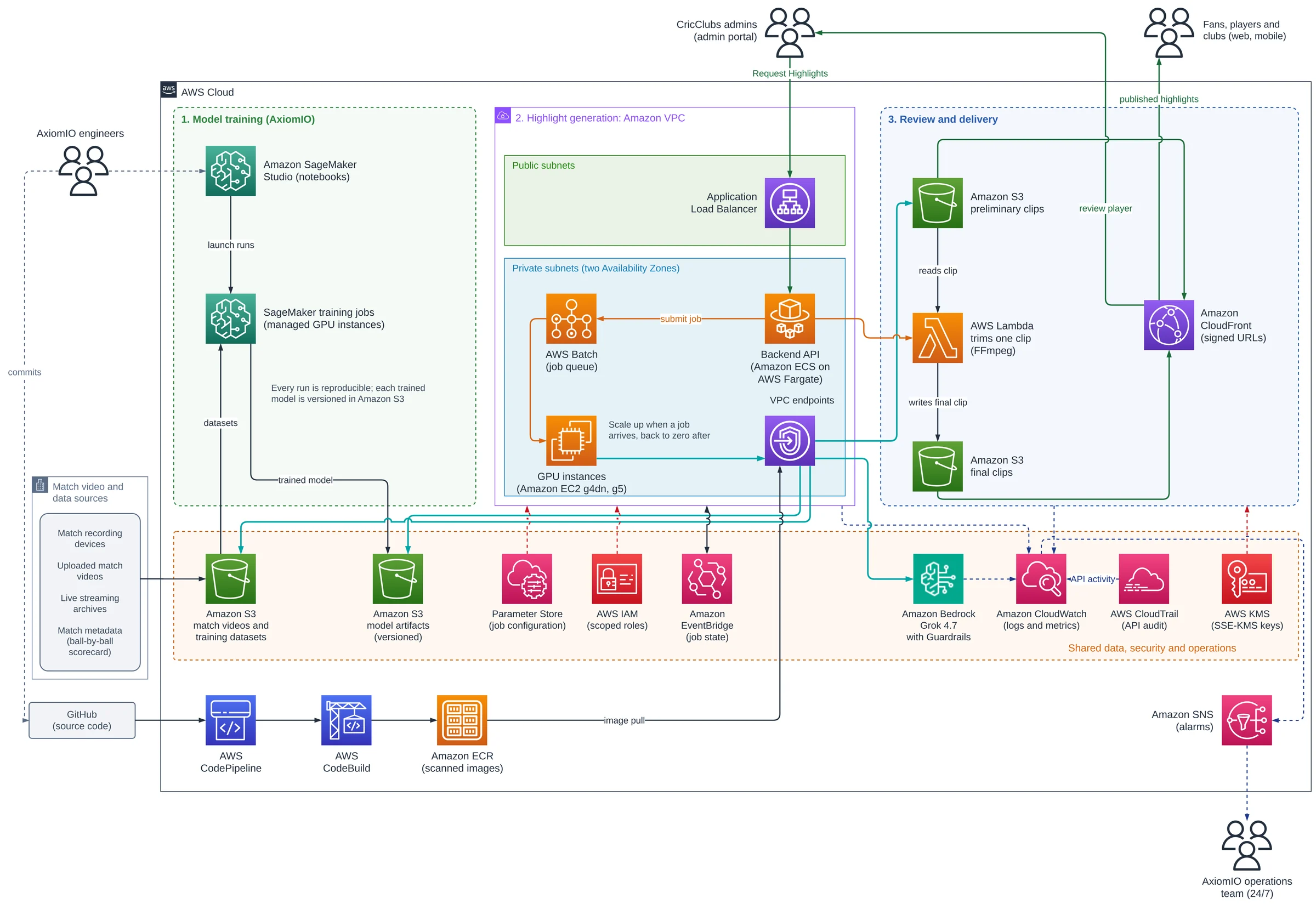
- Training runs offline. Match video lands in Amazon S3, engineers launch runs from SageMaker Studio, and every trained model is versioned back into S3. Each code change builds a scanned Docker image in Amazon ECR.
- When a match finishes, the admin clicks Request Highlights. The backend API on ECS submits an AWS Batch job that starts GPU instances in private subnets, reads the video, scorecard and model from S3 through VPC endpoints, detects key moments and writes clips. Grok 4.7 on Amazon Bedrock confirms, reclassifies or flags each moment and writes its text, with Bedrock Guardrails checking every response.
- CloudFront streams clips into the review player with their AI titles, captions and verdicts, flagged clips first. A Lambda function re-cuts any single clip in seconds, and approved highlights reach fans on the CricClubs web and mobile apps.
AI and AWS services: what each one does here
| Service | Role in the platform |
|---|---|
| Amazon SageMaker | Studio notebooks and managed GPU training jobs for the highlight detection models, with versioned artifacts in S3. |
| AWS Batch and Amazon EC2 (GPU) | Runs the inference container on G4dn and G5 instances, scaling from zero for each job and back to zero afterwards. |
| Amazon Bedrock | Runs Grok 4.7 to confirm, reclassify or flag each moment and write titles, captions and the recap, with Guardrails and invocation logging on. |
| Amazon S3 | Holds terabytes of match video, model artifacts and clips, encrypted with AWS KMS. |
| Amazon ECS on AWS Fargate | Runs the backend API that submits Batch jobs and trim requests. |
| AWS Lambda | Cuts a single clip again with FFmpeg to the admin's corrected timestamps. |
| Amazon CloudFront | Streams clips for review and delivers published highlights, with signed URLs for unpublished footage. |
| Amazon ECR, AWS CodePipeline and CodeBuild | Build, scan and keep the latest tested image ready for AWS Batch. |
Supporting AWS services: Amazon VPC, Application Load Balancer, Amazon Bedrock Guardrails, Amazon EventBridge, AWS Systems Manager Parameter Store, AWS IAM, AWS KMS, Amazon CloudWatch, Amazon SNS, AWS CloudTrail.
Other tools: Docker, Python, FFmpeg and GitHub.
In action
Match day: From final ball to first cut
Scenario: A league final finishes on a weekend afternoon and the admin wants highlights out while fans are still talking about the game.
The admin clicked Request Highlights. An AWS Batch job started a GPU instance, loaded the video and the latest model, and detected the wickets, boundaries, appeals and milestones. Grok 4.7 checked each moment against the scorecard, reclassified one appeal the scorer had recorded as a caught-behind wicket, and wrote a title and caption for every clip and a recap of the final. Within minutes everything was in the review player, and the GPU instance had scaled back to zero.
Human approval: Fixing one clip in seconds
Scenario: One boundary clip is flagged by Grok 4.7: the frames show the ball fielded inside the rope while the scorecard records four runs a delivery later.
The flag showed the clip started a delivery early. The admin moved the in point forward and saved it, and a Lambda function cut that one clip again in seconds. The rest of the reel was untouched, no GPU job ran again, and the approved highlights went out to fans, players and clubs.
Results: before and after
Four indicators show what changed once the platform went live.
| Indicator | Before | After | Change |
|---|---|---|---|
| Model training cycle | One to two days on a developer laptop | Hours on managed GPU instances | From days to hours |
| Time to a reviewable first cut | Manual editing: a person scrubbing hours of footage | Minutes after the match ends, with no manual editing | Manual editing removed from the first cut |
| Titles, captions and match recap | Written by hand for each clip, when time allowed | Drafted by AI for every clip and every match | Every clip ready to publish with text |
| Correcting one clip | Edited again by hand | Seconds, with an AWS Lambda cut of that one clip | No GPU job run again |
- Terabyte-scale datasets in Amazon S3. Full match video datasets with high-throughput reads and writes: no local disk ceiling.
- Detections checked before a person sees them. Grok 4.7 corrects mislabelled events and flags disagreements to the top of the queue, so the admin's attention goes where it is needed.
- One pipeline for every match. The same containerized, versioned pipeline produces highlights consistently across every match.
- No idle GPU. AWS Batch scales GPU compute up only for active jobs and back to zero afterwards.
Security and responsible AI
- Least-privilege IAM roles. The Batch job, Lambda function and backend API each assume a role scoped to only the S3 prefixes and actions they need.
- Private compute. GPU instances and the API run in private subnets and reach AWS services, including Bedrock, through VPC endpoints.
- Guardrails on every AI response. Contextual grounding against the scorecard, content and word filters for a family audience; failing output is flagged for the admin instead of written.
- A person approves before publishing. Every AI-cut clip and every AI-written title, caption and recap is reviewed by a CricClubs admin before it reaches fans.
- Encryption and controlled delivery. SSE-KMS at rest, TLS through CloudFront, and signed URLs for unpublished footage.
- Hardened images and audit. ECR image scanning, immutable tags, CloudTrail and CloudWatch log retention.
Source: CricClubs AI Cricket Match Highlights Platform case study, July 27, 2026. Figures as reported in the case study.
Work with AXIOMIO
AXIOMIO is an AWS Advanced Tier Partner, AWS MSP and Level 1 MSSP that builds and runs production AI on AWS. Generative AI services on AWS · Managed AI operations · Talk to an AI engineer